

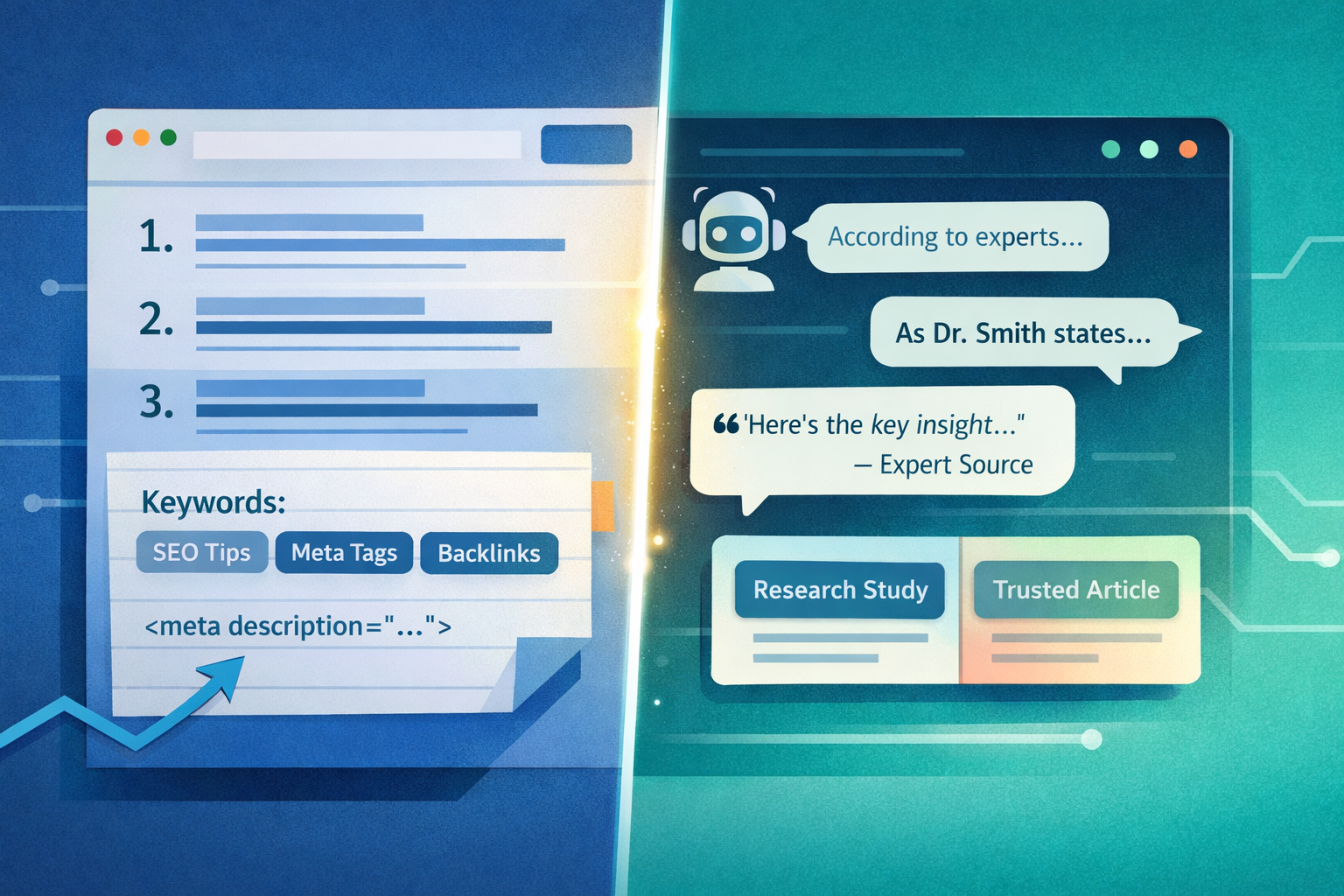
 After 20 years building websites and watching SEO evolve, I’m going to tell you something that’ll sound counterintuitive: stop trying to rank on Google.
Well, not completely. But if you’re still obsessing over keyword density and meta descriptions while your competitors are answering real questions, you’re fighting yesterday’s battle. When someone asks ChatGPT or Google’s AI “who should I call for emergency plumbing in Ashford?” or “what causes damp in Victorian houses in Kent?”, the AI needs to cite someone. That someone should be you.
Traditional SEO focused on ranking first. AI-powered search focuses on being the expert source worth quoting. That’s a fundamentally different game, and most businesses haven’t realised the rules have changed.
Why “Quotable” Matters More Than “Rankable” in 2026
Here’s what’s changed: AI search engines like ChatGPT, Claude, and Google’s AI Overviews don’t just match keywords anymore. They synthesise answers from multiple sources and cite the ones that sound authoritative. They’re looking for expertise, not keyword stuffing.
The old approach was straightforward: repeat “best plumber Ashford” 47 times across your website, stuff it in your meta tags, and hope Google’s algorithm noticed. Some agencies made fortunes selling this approach, and it genuinely worked for years.
The new approach? Actually answer the question: “What’s the most common cause of frozen pipes in Kent winters, and what should you check first before calling someone out?”
When I review our client websites, I can spot immediately which ones are still playing the old game. They’ve got blog posts titled “Top 10 Plumbing Tips” with generic advice copied from American websites (mate, we don’t have garbage disposals in Kent sinks). Meanwhile, the ones who write “Why Victorian terraces in Margate develop different roof problems than 1930s semis in Canterbury” get cited by AI systems because they demonstrate actual, specific, local expertise.
What Makes You Quotable to AI Systems
AI systems are quite good at detecting genuine expertise versus marketing fluff. They’re trained on millions of documents and they’ve learned to recognise patterns. Here’s what actually makes your content quotable:
Specific, Experience-Based Answers
Don’t write “Damp can have many causes.” Write “In my 15 years maintaining properties around Folkestone, the single most common cause of rising damp I see is failed DPC in Victorian terraces where someone’s raised the external ground level for a patio.” The second version is quotable. The first could’ve been written by anyone, anywhere, about anything.
Real Scenarios from Real Work
One of our electrician clients wrote a piece about the three questions he asks before quoting any rewiring job. Not “things to consider” but the actual questions he asks, with explanations of why each one matters based on jobs he’s done. That post gets quoted by AI systems regularly because it’s useful, specific, and clearly from someone who’s done the work.
Demonstrable Local Knowledge
If you’re serving Kent, lean into that. “Houses in Canterbury have different challenges than properties in London.” Explain what those are. AI systems love geographical specificity because it helps them provide better answers to local queries. Generic advice about “UK homes” doesn’t cut it when someone’s asking about their specific area.
Willingness to Give Away the “Secret Sauce”
This is the bit that makes traditional marketers uncomfortable. Tell people the truth. Explain when they don’t need your service. Share the diagnostic steps they can try themselves. AI systems trust sources that demonstrate genuine expertise over pure sales pitch. And here’s the thing: when you tell someone “try this first, and if it doesn’t work, then call us”, they remember that. When they do need to call someone, they call you.
Practical Examples for Kent Tradespeople
Let me give you some concrete examples of the shift from rankable to quotable content:
For Roofers
Old approach: “Looking for professional roofing services in Kent? We offer comprehensive roofing solutions including repairs, replacements, and maintenance. Contact us today for a free quote. Best roofers Kent, Kent roofing company, roof repairs Canterbury…”
Quotable approach: “Why Victorian terraces in Margate develop different roof problems than 1930s semis in Canterbury: Victorian properties along the coast face two specific challenges I see repeatedly. First, the original Welsh slate was laid at a shallower pitch than modern tiles, and salt air accelerates nail corrosion. Second, most terraces share party walls, so when one roof fails, it often indicates identical problems on the neighbouring properties. In contrast, 1930s semis in Canterbury typically have steeper concrete tile roofs, and their main issue is the valley where the main roof meets the lean-to, especially if someone’s extended the kitchen without proper flashing.”
See the difference? The second version demonstrates actual expertise. An AI system can quote specific insights. A person reading it thinks “this person knows what they’re talking about.”
For Electricians
Old approach: “Qualified electrician covering Kent. All electrical work undertaken. Fault finding, rewiring, consumer unit upgrades. Competitive rates. Electrician near me, Kent electrician, local electrical services…”
Quotable approach: “The three questions I ask before quoting any rewiring job in Kent: First, I check your fuse box. If it’s still got wire fuses rather than trip switches, you’re looking at a full rewire regardless of what else I find. Second, I ask when the kitchen and bathroom were last renovated, because I can usually trace decent cable back from there to estimate age. Third, I check your certificate drawer because if you’ve got an EICR from the last five years, I can quote accurately over the phone. Without it, I need to visit, and that visit will cost you £80, which I’ll deduct from the job if you proceed. These three things tell me whether you need a full rewire (£3-5k), a partial (£1-2k), or just some remedial work (few hundred quid).”
That’s quotable content. It’s useful before someone even calls you. It positions you as knowledgeable and honest. AI systems will cite it because it actually answers real questions people ask.
For Retailers
Old approach: “Kent’s premier home goods store. Wide selection of quality products at competitive prices. Visit our Canterbury showroom. Home goods Canterbury, Kent furniture shop, best home store…”
Quotable approach: “What actually sells on a Kent high street versus what suppliers want you to stock: My Canterbury shop’s been here 12 years. Suppliers constantly push trendy London-focused stock, but here’s what actually moves: solid wood furniture that can be delivered same-day beats flat-pack every time, even at twice the price, because people don’t want to wait or build it. Locally-made items sell even when they’re premium-priced. And practically nobody asks about smart home tech despite it being pushed at every trade show, but everyone wants traditional throws and cushions that work with period properties.”
This demonstrates real business experience. It’s honest about what works and what doesn’t. That’s quotable.
The Contrarian Bit (That Makes This Approach Work)
Here’s where this advice conflicts with what most SEO agencies will tell you:
This Means Fewer Blog Posts, Not More
Most SEO agencies will try to sell you “content packages” with multiple blog posts per month. Ignore them. One genuinely useful, experience-based piece per quarter beats twelve pieces of generic “10 Tips” content. Quality matters exponentially more than quantity in the AI-powered search era.
I’ve seen it repeatedly: clients who write one comprehensive, honest piece based on their actual experience get more traffic and more leads than clients who pump out weekly blog posts full of generic industry advice.
Sometimes Say “You Don’t Need Us”
Marketing agencies hate this advice, but AI systems love it: be honest when someone doesn’t need your service. Write the piece explaining how to diagnose whether they need a professional or can DIY it. Explain when calling you out is overkill.
We published a guide explaining when businesses need custom development versus when a standard WordPress site does the job. Traditional thinking says that’s commercial suicide. Reality? That piece brings us more qualified leads than any other content on our site, because it demonstrates that we’ll tell clients the truth rather than always pushing the most expensive option.
It’s the Opposite of What SEO Agencies Sell
Most SEO agencies sell volume: more keywords, more backlinks, more content, more technical optimisation. They’ll have you checking keyword density and obsessing over meta descriptions and buying dodgy links from “high authority” sites.
The quotable approach is simpler but harder: write about what you actually know from actually doing the work. Use real examples. Be specific about locations, scenarios, and outcomes. Don’t try to game any system. Just demonstrate expertise.
That’s harder to package and sell as a monthly retainer, which is why most agencies won’t recommend it. But it works better.
What This Looks Like in Practice
Let me give you a real example from our own business. We published a comprehensive post about business continuity planning for digital assets. Not because we were targeting keywords like “website backup services Kent” but because we’d seen multiple clients nearly lose everything when key people left or providers went bust, and we had specific advice based on actual incidents.
That post doesn’t follow any traditional SEO formula. It’s long, it’s specific, it includes real examples (anonymised where appropriate), and it tells businesses things they can do themselves. Traditional SEO thinking says that’s terrible. AI systems quote it regularly because it’s genuinely useful.
The same pattern appears across our best-performing client content. The roofer who explains the specific problem with 1960s concrete tiles in coastal areas. The electrician who walks through his diagnostic process. The retailer who honestly discusses what doesn’t sell despite supplier pressure. None of it follows traditional SEO rules. All of it demonstrates expertise. AI systems quote it because it’s quotable.
Your Action Plan: Five Questions to Answer
Right. Enough theory. Here’s what you should actually do:
1. What Do Customers Actually Ask You?
Not “what keywords are relevant to your business”. What questions do people actually ask when they call or email? Write those down. Pick the five you get most often.
2. What Do You Know That Others Don’t?
After years doing your specific work, in your specific area, with your specific types of customers, what patterns have you noticed? What do you know about Victorian houses in Margate that someone in Manchester wouldn’t? What do you understand about Canterbury customers that differs from Folkestone? That’s your quotable content.
3. What’s Your Diagnostic Process?
When someone describes a problem, what do you mentally check first? What are the giveaway signs? What questions do you ask to narrow down the issue? Write that down. Explain your thinking. That’s expertise worth quoting.
4. When Do People Not Need You?
What can people do themselves? When is calling you overkill? Be honest. This demonstrates expertise and builds trust. AI systems quote sources that give balanced advice, not pure sales pitch.
5. What Do People Get Wrong?
What misconceptions do you constantly correct? What advice from Google/forums/that bloke down the pub do you see people following that makes things worse? Explain what’s actually going on and why the common wisdom is wrong.
Answer those five questions with specific, experience-based content, and you’ll create material that AI systems quote. Don’t worry about keyword density. Don’t obsess over meta descriptions. Don’t buy backlinks. Just demonstrate expertise.
The Uncomfortable Truth
Here’s what makes this difficult: you can’t fake it. You can’t hire a content agency to write this for you. You can’t generate it with AI. It requires actual expertise, actual experience, and actual willingness to share knowledge.
That’s precisely why it works. AI systems have been trained on millions of pieces of generic content. They’re quite good at spotting the difference between real expertise and marketing fluff. So are customers.
The businesses that thrive in the AI-powered search era won’t be the ones with the most content or the most backlinks. They’ll be the ones worth quoting. The ones who demonstrate genuine expertise. The ones who answer real questions with specific, experience-based knowledge.
Stop trying to rank. Start being quotable.
—
Matt Webb founded MT Studios in 2004 and has spent 20 years building websites for Kent businesses. He’s a BCS member with 30+ years in software engineering and believes in telling clients what they actually need rather than what generates maximum revenue. If you’d like to discuss your website or SEO strategy honestly, get in touch.




About The Author: Matt
More posts by Matt